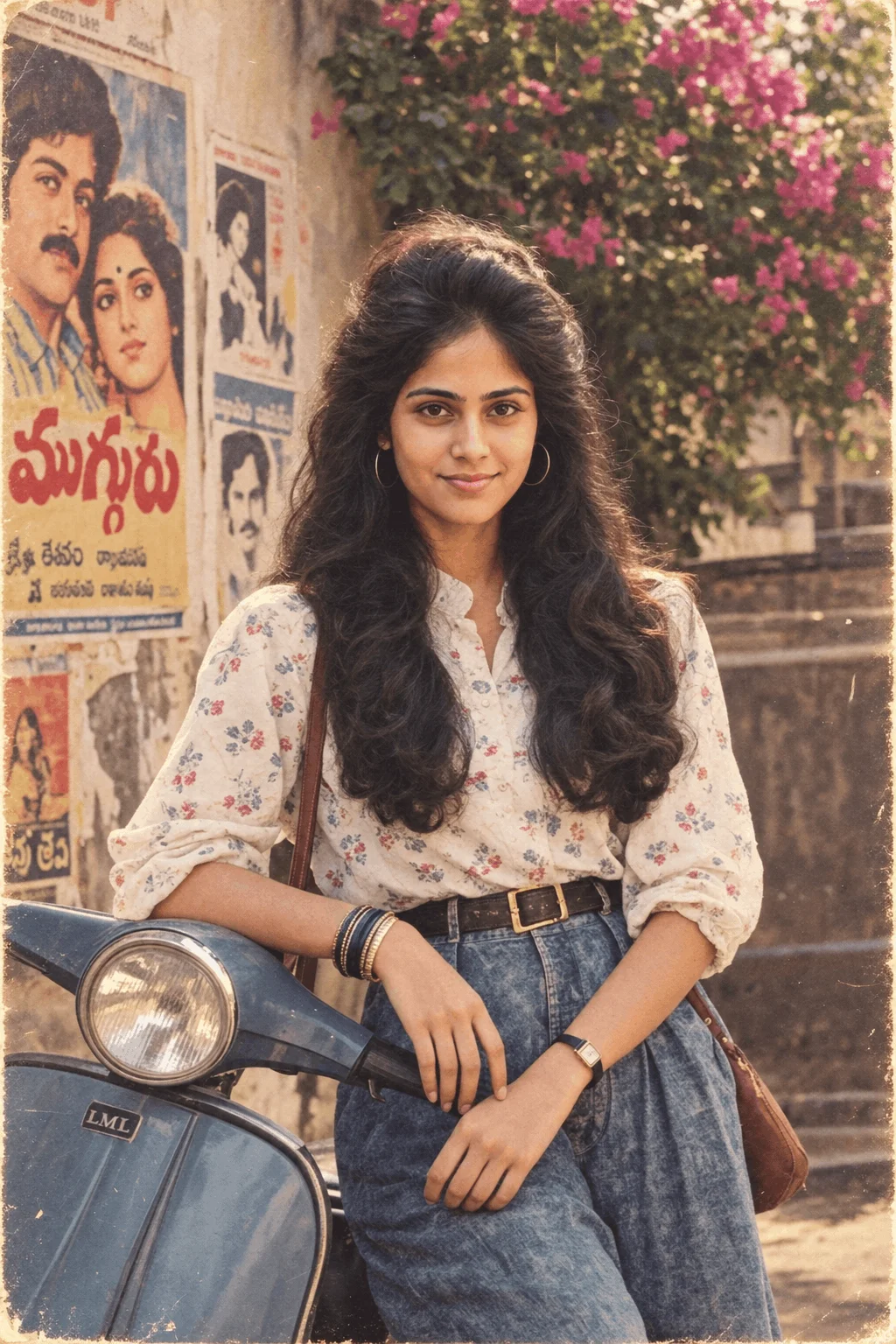
Create an extremely realistic, historically authentic Indian photograph from approximately the mid-to-late 1980s, as though this exact scene was genuinely photographed in India using a real analog 35mm color-film camera and period-appropriate color negative film.
IMPORTANT:
Do NOT create a modern photograph with an 1980s filter.
Do NOT create a modern woman wearing retro clothing.
Do NOT create a contemporary fashion editorial.
Do NOT use digital cinematic color grading to simulate the period.
The entire scene must physically and visually belong to approximately 1985–1989 India.
Use the uploaded reference image as the STRICT PRIMARY VISUAL REFERENCE.
Reproduce the reference as closely as possible in:
- composition
- framing
- camera position
- camera height
- subject scale
- body posture
- head tilt
- facial expression
- gaze direction
- hairstyle
- hair volume
- earrings
- saree
- blouse
- bangles
- wristwatch
- hand positions
- vintage scooter
- headlight
- background wall
- old cinema poster
- flowering plants
- architecture
- sunlight
- shadows
- depth of field
- color palette
- analog photographic softness
- film grain
- overall nostalgic atmosphere
Do not redesign the scene.
Do not change the woman's pose into a generic fashion pose.
Do not replace the scooter with a modern vehicle.
Do not remove the old poster or flowering background.
Do not modernize any visible object.
SUBJECT:
Show one young adult Indian woman positioned prominently in the center-right portion of the vertical frame.
She is seated/leaning naturally against a vintage scooter, following the exact overall pose and body positioning of the reference.
Her upper body is turned generally toward the camera.
Her head is tilted gently toward one side.
She looks directly toward the camera with a calm, warm and subtly confident expression.
Her expression is natural and understated, with a very slight closed-mouth smile.
She should look like a real woman photographed casually in India during the 1980s, not like a contemporary professional model.
FACE:
Create a natural, realistic young Indian woman's face.
Preserve realistic:
- forehead proportions
- eyebrows
- eyes
- nose
- cheeks
- lips
- jawline
- chin
- ears
- facial asymmetry
Her eyes should look directly toward the camera.
Her expression should be gentle, confident and relaxed.
Her lips should have a subtle natural reddish tint.
Do not exaggerate the smile.
Do not make her face look like a generic AI beauty model.
Do not over-retouch the face.
If an identity reference is separately provided, preserve the person's recognizable facial identity and facial characteristics as accurately as possible while maintaining this exact reference composition.
SKIN:
Use natural Indian skin texture.
Include subtle:
- pores
- natural tonal variation
- realistic highlights
- gentle shadows
- minor imperfections
Avoid:
- plastic skin
- porcelain skin
- excessive smoothing
- airbrushing
- beauty filters
- CGI skin
- unnaturally perfect complexion
The warm sunlight should naturally illuminate her face.
HAIR:
The woman's hair is one of the most important visual elements.
She has very long, thick, dark brown-to-black hair.
The hairstyle is distinctly 1980s Indian.
Her hair has substantial volume around the crown and sides.
The front section is styled with a soft side part and swept naturally away from the face.
Large flowing sections of hair fall over her shoulders and down the front of her body.
The hair should extend well below her shoulders.
Create:
- thick natural volume
- soft waves
- subtle curls
- layered sections
- loose strands
- natural flyaways
- individual hairs catching sunlight
The hair should NOT look like modern perfectly straightened salon hair.
It should have the slightly imperfect, naturally voluminous appearance characteristic of period photography.
Create warm sunlight highlights along some outer strands.
Do not make the hair excessively glossy or digitally perfect.
EARRINGS:
She wears large circular hoop earrings.
The hoops are simple, elegant and period appropriate.
They should be clearly visible on both sides of her face.
Use thin metallic hoops with subtle natural reflections.
Do not replace them with contemporary statement jewelry.
SAREE:
The woman is wearing a classic black/dark charcoal Indian saree covered with evenly distributed light beige/golden circular polka dots.
The saree is one of the strongest visual elements.
Use:
- deep black or very dark charcoal base
- small-to-medium cream/golden circular dots
- soft lightweight fabric
- natural draping
- realistic folds
- subtle fabric texture
The polka dots should be printed into the fabric, not floating on top of it.
The dots should remain visible across the pleats and folds while naturally following the fabric's perspective.
Do not make the saree glossy like modern synthetic fashion fabric.
Keep the fabric matte-to-soft with realistic period textile behavior.
PALLU:
The saree pallu crosses diagonally across her torso from one shoulder downward.
It should follow the reference composition precisely.
The pallu contains the same dark fabric and repeated light circular pattern.
The border should be subtle and consistent with the reference.
The draping must look like a real Indian saree worn naturally.
Do not create impossible folds.
Do not make the saree look digitally painted.
BLOUSE:
She wears a fitted black blouse underneath the saree.
The blouse has short sleeves.
The neckline is modest and approximately square/scoop shaped, following the reference.
The blouse should have realistic fabric texture and natural folds around the shoulders and arms.
Do not modernize the blouse.
BANGLES:
Her wrist contains several traditional dark/gold-toned bangles.
The bangles should be stacked naturally around the wrist.
Create subtle metallic reflections and realistic overlap between individual bangles.
Do not add excessive jewelry.
Keep the jewelry elegant and period appropriate.
WRISTWATCH:
Include a small classic analog wristwatch on the opposite wrist.
The watch should look like a genuine 1980s wristwatch.
Use:
- simple analog face
- small case
- period-appropriate strap
- subtle metallic details
No smartwatch.
No digital fitness tracker.
No modern luxury watch.
HANDS:
Reproduce the reference hand positions accurately.
One arm rests naturally on or near the vintage scooter.
The other hand rests comfortably across the lower torso/lap area.
The fingers should be relaxed.
Hands must have realistic anatomy:
- exactly five fingers
- correct thumb placement
- realistic finger lengths
- natural joints
- believable fingernails
- natural wrist proportions
Avoid:
- extra fingers
- missing fingers
- fused fingers
- malformed palms
- distorted wrists
POSE:
The woman's posture should be relaxed and natural.
She is positioned close to the vintage scooter.
One arm rests naturally against the scooter.
Her other hand rests gently near the saree at waist/lap level.
Her shoulders are relaxed.
Her head is slightly tilted.
Her body remains elegant but casual.
The pose must resemble an authentic personal photograph rather than a deliberately staged fashion shoot.
VINTAGE SCOOTER:
A classic Indian vintage scooter occupies a substantial portion of the lower-left foreground.
The scooter should have authentic older styling appropriate to approximately the 1980s.
Its body is a muted blue-gray / dusty blue color.
Include:
- large circular headlight
- chrome headlight surround
- rounded front body panel
- classic metal construction
- period-appropriate handlebars
- old-style scooter proportions
- chrome trim
- aged painted surfaces
The front headlight should be prominently visible in the lower-left area.
The scooter paint should have subtle age:
- minor scratches
- slight fading
- small imperfections
- realistic dust
- natural reflections
The scooter should look like a real older Indian scooter that was actually being used in the 1980s.
Do NOT use a modern scooter with retro styling.
Do NOT use modern plastic bodywork.
Do NOT add modern LED lights.
Do NOT add modern digital displays.
Do NOT add modern logos or accessories.
AUTOMOBILE/SCOOTER DETAIL:
The headlight glass should have realistic ridges and reflections.
The chrome trim should show soft highlights.
The painted metal should reflect the warm environment naturally.
Do not make the scooter look freshly restored or showroom perfect.
BACKGROUND:
Create a quiet Indian residential/urban environment appropriate to approximately 1985–1989.
The woman is standing/seated near an aged wall.
The wall has a warm beige/cream plaster surface.
It should show realistic age and imperfections:
- faded paint
- subtle stains
- weathering
- uneven plaster
- small cracks
- old surface texture
Behind the woman are flowering plants with abundant pink/magenta flowers and green leaves.
The flowers should resemble naturally growing bougainvillea or similar flowering vines common in Indian residential environments.
The flowers create a colorful soft background.
Do not make the flowers perfectly arranged.
Allow natural irregular growth.
OLD CINEMA POSTER:
On the left side of the background, include a large faded vintage Indian cinema poster attached to the wall.
The poster should look physically old and weathered.
It should contain painted/printed faces and old-fashioned Indian cinema typography.
The poster should appear partially cropped by the frame.
Its colors should be faded:
- muted red
- brown
- cream
- yellow
- dark tones
The poster must look like genuine period paper/poster material.
Include:
- paper aging
- faded ink
- slight tearing
- weathering
- uneven edges
Do NOT use a modern movie poster.
Do NOT use crisp modern typography.
Do NOT introduce contemporary celebrities, logos or advertisements.
If text appears, it should look naturally printed or painted and slightly softened by the analog photograph.
FLOWERING BACKGROUND:
The upper-right and upper-center background contains dense green foliage with clusters of pink flowers.
Use natural sunlight filtering through leaves.
Create varying levels of focus:
- some flowers softly recognizable
- distant foliage naturally blurred
- small bright highlights
- realistic leaf texture
Do not make the background look like a digital floral backdrop.
LIGHTING:
Use warm natural afternoon sunlight.
The sunlight comes from the upper/front side and creates a beautiful warm glow across the woman's face and hair.
Create:
- warm highlights on hair
- soft illumination on skin
- gentle highlights on the saree
- subtle reflections on the scooter chrome
- dappled sunlight in the foliage
- warm highlights on flowers
The shadows should remain soft and believable.
Do NOT use studio lighting.
Do NOT use ring lights.
Do NOT use neon lighting.
Do NOT use RGB lighting.
Do NOT use modern cinematic lighting.
Do NOT use HDR.
CAMERA:
Photograph the scene as though captured using a real 1980s analog 35mm camera.
Use a natural portrait perspective approximately equivalent to a 50–85mm lens.
Camera height should be around the woman's upper torso/face level.
Avoid wide-angle distortion.
Avoid fisheye distortion.
Keep her facial proportions natural.
The camera should feel physically positioned in front of the subject rather than digitally generated.
FRAMING:
Use a vertical portrait composition matching the uploaded reference.
The woman's face occupies approximately the upper-middle/right-center region.
Her long hair extends downward through much of the central frame.
Her saree fills much of the lower-right portion.
The vintage scooter occupies the lower-left foreground.
The large circular headlight is clearly visible.
The old cinema poster appears on the upper-left.
Pink flowering foliage fills the upper background.
Maintain the same visual balance and crop as the reference.
Do not center the woman symmetrically.
Do not remove the scooter.
Do not crop away the headlight.
Do not remove the poster.
DEPTH OF FIELD:
Use moderate shallow depth of field.
The woman's face, eyes, earrings and front hair should be the primary focus.
The saree and hands should remain sufficiently detailed.
The scooter should remain recognizable.
The background poster, flowers and foliage should gradually soften with distance.
Do not use excessive artificial computational bokeh.
Do not blur the entire background.
The background should remain recognizable as a real location.
PHOTOGRAPHIC COLOR:
Use authentic 1980s Indian color-film rendering.
Primary palette:
- warm beige
- muted brown
- deep charcoal/black
- cream
- faded blue
- natural green
- pink/magenta
- warm skin tones
The colors should be slightly faded but still naturally colorful.
The black saree should remain dark charcoal/black rather than becoming completely crushed.
The beige dots should remain visible.
The scooter should remain muted blue.
The flowers should retain natural pink tones.
The skin should retain warm natural color.
Do NOT turn the image completely sepia.
Do NOT apply an orange Instagram filter.
Do NOT oversaturate.
ANALOG FILM CHARACTER:
The photograph must convincingly resemble a real scanned 1980s color photograph.
Include:
- organic 35mm film grain
- subtle color noise
- mild photographic softness
- gentle highlight bloom
- slight halation around bright areas
- soft highlight roll-off
- slightly faded blacks
- restrained contrast
- natural exposure imperfections
- subtle color shifts
- slight print/scanning texture
The grain must be integrated into the actual photographic rendering.
Do NOT simply overlay digital grain on a modern image.
Do NOT make the image artificially scratched.
Do NOT add VHS glitches.
Do NOT add fake dust particles.
Do NOT add fake film borders.
Do NOT add sprocket holes.
Do NOT add excessive light leaks.
The photograph should look like a real physical print from the 1980s.
HISTORICAL AUTHENTICITY:
Every visible element must be consistent with approximately 1985–1989 India.
Period authenticity must include:
- hairstyle
- saree styling
- blouse
- jewelry
- bangles
- analog wristwatch
- scooter
- wall
- cinema poster
- flowers
- architecture
- photographic equipment
- film rendering
Do not include:
- smartphones
- modern vehicles
- modern scooters
- modern watches
- modern jewelry
- modern advertisements
- LED lights
- contemporary architecture
- modern street signs
- modern fashion accessories
FINAL VISUAL TARGET:
The finished photograph should immediately feel like a genuine Indian family/personal portrait from the 1980s.
It should feel warm, intimate, nostalgic, slightly imperfect and naturally photographed.
A viewer should believe that this woman, her black polka-dot saree, vintage scooter, old cinema poster, flowering plants and weathered wall were all physically present and photographed together in India during the 1980s.
It should NOT look like:
- a modern photograph with a vintage preset
- a modern fashion editorial
- AI-generated retro fashion
- a movie poster
- CGI
- 3D rendering
- digital illustration
- modern DSLR photography
- Instagram vintage editing
It must look like a genuine analog photograph from the period.
OUTPUT:
Vertical portrait.
Aspect ratio: 9:16.
Target size: 1080 × 1920 pixels.
Ultra-realistic photographic rendering.
Authentic approximately 1985–1989 Indian analog color-film appearance.
Strictly preserve the uploaded reference composition, pose, clothing, scooter and background arrangement.
PRESERVE THE UPLOADED REFERENCE FIRST.
1. Exact overall composition and vertical framing.
2. Exact woman positioning relative to the scooter.
3. Head tilt and direct camera gaze.
4. Calm subtle facial expression.
5. Very long, thick, voluminous dark hair.
6. Large circular hoop earrings.
7. Black/dark saree with cream/golden polka dots.
8. Black short-sleeved blouse.
9. Natural saree draping and pallu direction.
10. Stacked bangles.
11. Vintage analog wristwatch.
12. Exact relaxed hand positions.
13. Muted blue vintage scooter.
14. Large round headlight in the lower-left.
15. Weathered wall behind the subject.
16. Old Indian cinema poster on the left.
17. Dense green foliage and pink flowers.
18. Warm natural sunlight.
19. Soft analog photographic depth.
20. Authentic 1980s color-film texture.
21. No modern objects.
22. No modern fashion.
23. No modern digital photography appearance.
24. Do not achieve the period appearance merely through a vintage filter.
25. Make the entire scene physically believable as an actual photograph captured in India around 1985–1989.
26. Output 1080 × 1920, 9:16 vertical.
Negative : modern digital photography, smartphone photograph, modern DSLR photograph, mirrorless camera look, computational photography, HDR, ultra sharp digital image, excessive clarity, modern fashion editorial, contemporary fashion, modern saree styling, modern hairstyle, modern jewelry, modern handbag, smartwatch, digital watch, smartphone, modern scooter, modern vehicle, futuristic scooter, LED headlight, modern plastic scooter, modern architecture, modern advertisements, modern cinema poster, contemporary poster, modern typography, modern street furniture, generic AI woman, different face, distorted face, plastic skin, waxy skin, airbrushed skin, beauty filter, excessive skin smoothing, unnatural eyes, distorted nose, distorted lips, exaggerated smile, distorted jawline, short hair, flat hair, modern straightened hair, insufficient hair volume, missing hoop earrings, incorrect saree, missing polka dots, incorrect saree draping, modern blouse, malformed hands, extra fingers, missing fingers, fused fingers, distorted wrists, unnatural finger positions, distorted body, distorted scooter, warped headlight, modern scooter body, excessive chrome, CGI, 3D render, illustration, anime, painting, cartoon, fantasy, surrealism, studio lighting, ring light, flash photography, neon lighting, RGB lighting, cinematic lighting, teal-orange grading, extreme saturation, oversaturated colors, orange skin, extreme yellow tint, heavy sepia, monochrome, fake vintage filter, fake retro filter, excessive film grain, fake scratches, fake dust, VHS effect, glitch effect, fake film borders, sprocket holes, excessive light leaks, heavy vignette, crushed blacks, blown highlights, artificial bokeh, completely blurred background, fisheye distortion, wide-angle distortion, low resolution, pixelation, compression artifacts, watermark, random logo, random text
 Boys
Boys
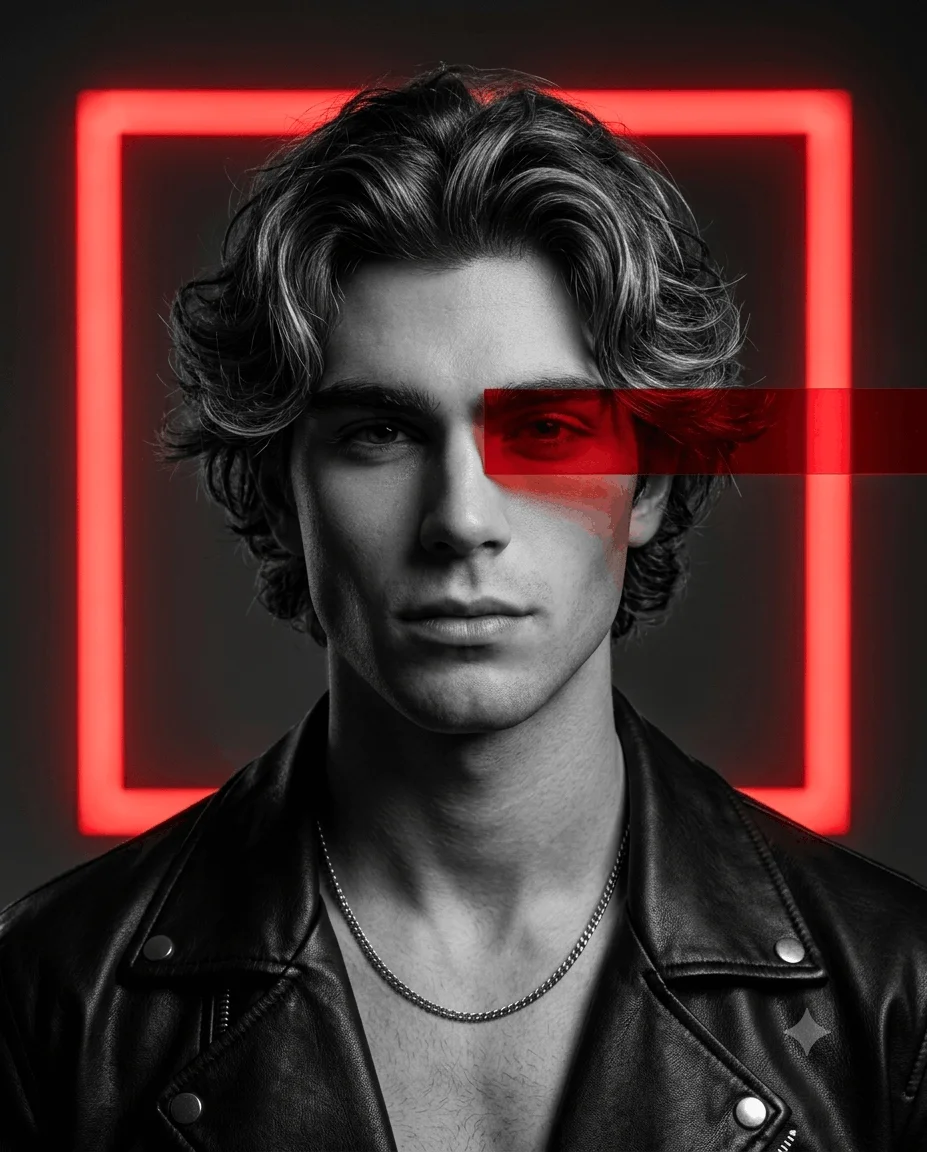
CINEMATIC BLACK-AND-WHITE PORTRAIT Prompt
CREATE A CINEMATIC BLACK-AND-WHITE PORTRAIT PHOTO EDITING PROMPT OF A HANDSOME YOUNG MAN